Discover our Microbe of the Month,the remarkable Galdieria sulphuraria, presented by Marina Lopez Morales, PhD student at Wageningen University. Marina won the Microbe of the Month contest organized by Micropia with her inspiring submission. The article below is the original text she wrote for the competition. Following her selection, Micropia invited Marina to present the fascinating world of extremophiles in a dedicated video.Galdieria sulphuraria is an extremophilic microalgae species that inhabits volcanic hot sulfur springs, and that has lately become one of the most acclaimed rock stars in biotechnology. It is part of the class Cyanidiphyceae, that encompasses most of the photosynthetic microorganisms capable of thriving in these hot and acidic environments, withstanding temperatures up to 56 °C and pH values ranging from 0 to 4. This is already enough to consider it as one of the toughest organisms on Earth”, you could say. But G. sulphuraria stands out from its relatives (other members of the class) with regards to mind-blowing physiological features, being also able to tolerate high concentrations of toxic metals such as arsenic, mercury or cadmium. In fact, in areas highly contaminated with these elements, this species represents most of the biomass, indicating that its metals tolerance is beyond comparison.
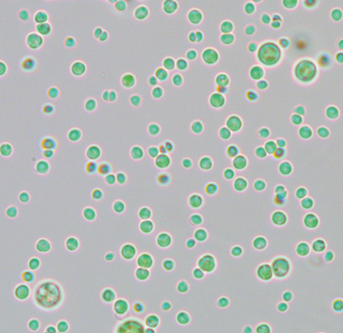
Galdieria sulphuraria growing in volcanic springs in Yellowstone Park
For if you are not yet speechless, here is more: although G. sulphuraria is by definition a photoautotrophic microorganism that relies on photosynthesis to grow, it is known to have an outstanding metabolic versatility and can feed on multiple organic substrates (more than 50 different ones!). This possibility of growing heterotrophically on a wide range of molecules, and the combination of both autotrophic and heterotrophic metabolisms (known as mixotrophy), surely helps them to withstand hostile conditions.
But, where do all these “superpowers” come from? And why does G. sulphuraria exhibit a larger set of abilities than its “sisters” species? Genomic comparative and phylogenetic studies have pointed out that the reason why Galdieria is such a singular microorganism has to do partially with the “stealing” of genes, an uncommon evolutionary process in eukaryotic cells. As many bacteria and archaea do, G. sulphuraria seems to have acquired part of its genetic pool through horizontal gene transfer mechanisms, with this phenomenon potentially being at the core of their extremophilic metabolism.
The temperature-resistant capacities may be directly borrowed from archaeal genes; while the ability to grow in a highly acidic environment seems to be related to a very low proton permeability throughout the cellular membrane, which allows the cells to maintain neutral intracellular pH at a very low energetic cost. Both the metals resistance and the organic carbon consumption traits are hypothesized to occur due to the presence of different membrane transporters, many of them identified as originally coming from thermo-acidophilic bacteria or archaea species.
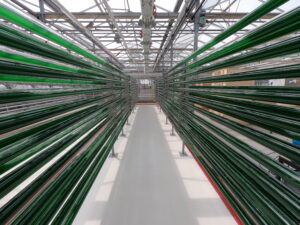
Galdieria sulphuraria growing in a pilot scale tubular photobioreactor in AlgaePARC (WUR)
We could argue that what makes Galdieria sulphuraria a unique poly-Xtremofile is, overall, that it has become a very good DNA thief throughout evolution, gathering different metabolic traits from other microorganisms. A combination of both vertical and horizontal gene transferring mechanisms has resulted in this Xceptional species with enormous biotechnological potential.
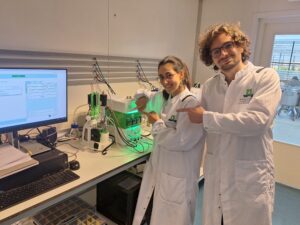
Marina Lopez Morales and Francesco Giambalvo, PhD candidates at Wageningen UniversitySources:
Schönknecht, G. et al. Gene Transfer from Bacteria and Archaea Facilitated Evolution of an Extremophilic Eukaryote. Science339, 1207–1210 (2013).
Retta, B., Iovinella, M. & Ciniglia, C. Significance and Applications of the Thermo-Acidophilic Microalga Galdieria sulphuraria (Cyanidiophytina, Rhodophyta). Plants13, 1786 (2024).
Barbier, G. et al. Comparative Genomics of Two Closely Related Unicellular Thermo-Acidophilic Red Algae, Galdieria sulphuraria and Cyanidioschyzon merolae , Reveals the Molecular Basis of the Metabolic Flexibility of Galdieriasulphuraria and Significant Differences in Carbohydrate Metabolism of Both Algae. Plant Physiology137, 460–474 (2005).
To provide the best experiences, we use technologies such as cookies to store and/or access device information. Consent to these technologies will allow us to process data such as browsing behaviour or unique IDs on this site. Not consenting or withdrawing consent may negatively affect certain features and functions.
Fonctional
Toujours activé
Access or technical storage is strictly necessary for the legitimate interest of enabling the use of a specific service explicitly requested by the subscriber or user, or for the sole purpose of transmitting a communication over an electronic communications network.
Préférences
L’accès ou le stockage technique est nécessaire dans la finalité d’intérêt légitime de stocker des préférences qui ne sont pas demandées par l’abonné ou l’internaute.
Statistics
Le stockage ou l’accès technique qui est utilisé exclusivement à des fins statistiques.Storage or technical access that is used exclusively for anonymous statistical purposes. In the absence of a court order, voluntary compliance by your internet service provider, or additional records from a third party, information stored or extracted for this purpose alone cannot generally be used to identify you.
Marketing
Technical access or storage is necessary to create user profiles for the purpose of sending advertisements or tracking users across a single website or across multiple websites for similar marketing purposes.